
Still Bowling Alone

Photo by Anna Shvets (Pexels)
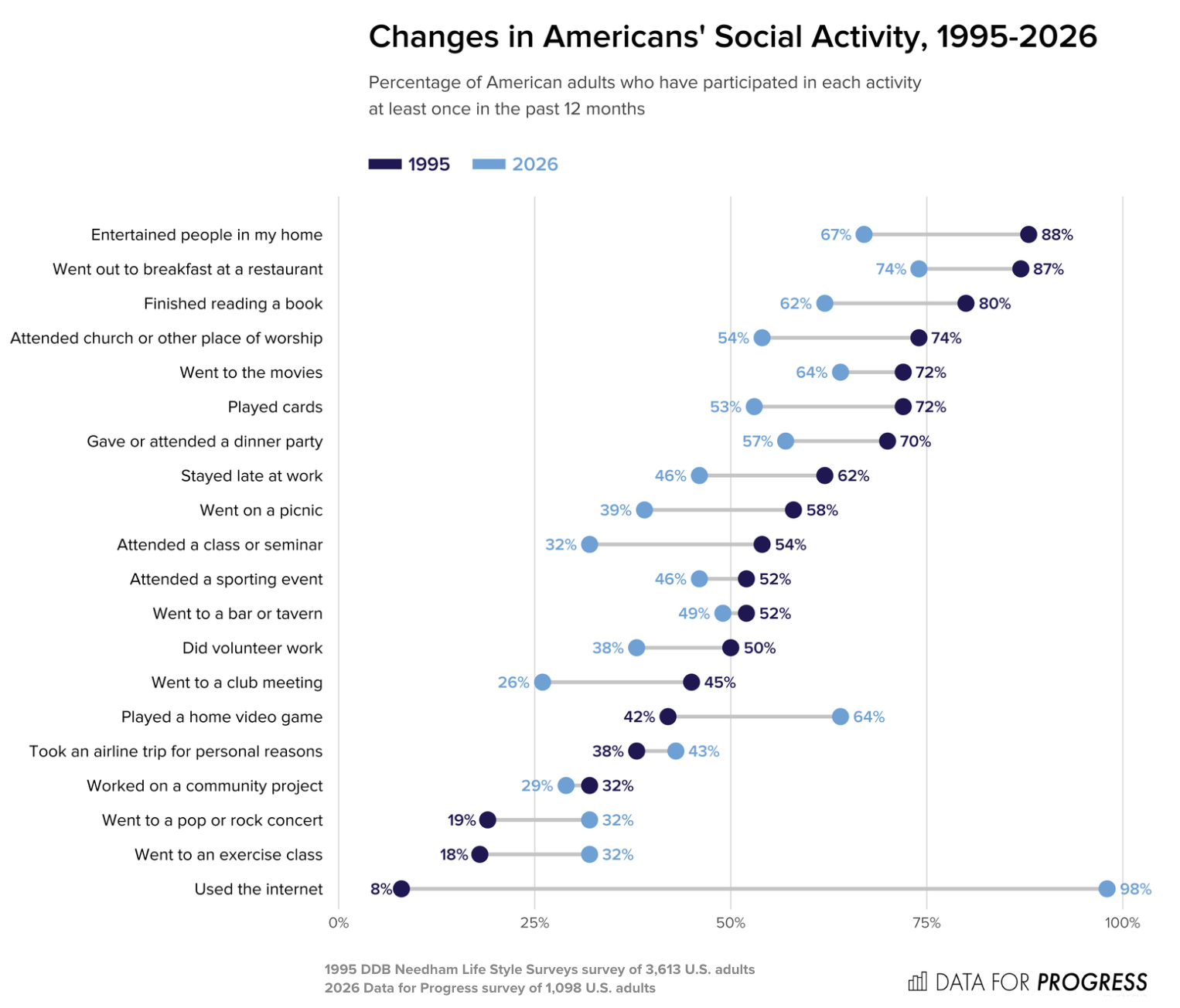
Data for Progress has compared social activities among American adults in 1996 against 2026. Findings? “Hanging out with others is down a lot.”
As in double-digit “a lot.”
Attending a class or seminar? Down 22%.
Entertaining people in your home? Down 21%.
Attending church or a place of worship? Down 20%.
Going on a picnic, going to a club meeting, or playing cards? All down 19%.
The only activities that have increased are ones that you would tend to do by yourself, such as using the internet (up 90%) or playing a home videogame (up 22%).
As I noted in an earlier blog, there is a myth that Americans were happily social before the events of 2020. But once the pandemic hit, we retreated into isolated lives, and only now are we inching our way out.
It’s more than that.
As journalist Derek Thompson points out in an interview with Lora Kelley, the “anti-social century is the opposite of that story.” In truth, “Every single demographic of Americans now spends significantly less time socializing than they did at the beginning of the 21st century, when some people already thought we were in a socializing crisis.”
He is, no doubt, referring to the work of Robert Putnam. In his groundbreaking book Bowling Alone, Putnam noted the loss of social capital in the world. As the title suggests, once we bowled in leagues, now we bowl alone. Long before the time when the internet became the wallpaper of our lives (Putnam’s book was released in 2000), there were already signs of our culture becoming increasingly disconnected from family, friends, neighbors and other social structures. Putnam notes that as the 19th century turned into the 20th, social capital was also at a low point. Urbanization, industrialization, and widespread immigration uprooted Americans from friends, social institutions and families. New organizations were created to fill the need. His book argued that the same need would need to be met in the 21st century.
Overall, Thompson said, “Americans spend about 20% less time socializing than they did at the beginning of the century. For teenagers and for young Black men, it’s closer to 40%.” As one economist told him, “We were more alone in 2023 than we were in 2021.”
Some of this can be attributed to technology. As Thompson notes, “with cars and television, and ultimately smartphones, [Americans can] privatize their leisure.” But since Putnam’s work came out in 2000, and the first smartphone wasn’t released until 2007, there would seem to be something deeper at hand.
Specifically, I would argue that it’s the loss of our collective understanding of, and participation in, Christian community. At least for the United States. Few have reflected deeply on what the rise of the “nones” has done for our collective sense of community. Meaning, with the loss of faith comes a loss of community.
Regardless, Thompson is on to something when he says that “self-imposed solitude might just be the most important social fact of the 21st century in America.”
James Emery White
Sources
“Decline in American Social Activities,” FlowingData, October 12, 2026, read online.
Lora Kelley, “How Solitude Is Rewiring American Identity,” The Atlantic, January 8, 2025, read online.
Derek Thompson, “The Anti-Social Century,” The Atlantic, January 8, 2025, read online.
Robert Putnam, Bowling Alone.